Overview
A geodesic in a metric space can be thought of as an isometry map from \([0,1]\) to the space. A quasi-geodesic in a metric space is a quasi-isometry from a closed interval in \(\mathbb{R}\), say \([a,b]\), to the space with quasi-geodesic parameters usually denoted by \(\lambda,\kappa\). A bounded quasi-geodesic combing of a space is an assignment of a quasi-geodesic between every pair of distinct points of the space so that they diverge in a bounded way, i.e., if \(q_1:[0,T_1]\to X\) and \(q_2:[0,T_2]\to X\) are two quasi-geodesics starting from the same point, then \[d(q_1(i),q_2(i))\leq\kappa_0 d(q_1(T_1),q_2(T_2))+\kappa_0\quad\forall i\] We call a quasi-geodesic \(\gamma\), \(m-\)Morse, if every \((Q,q)-\)quasi-geodesic whose endpoints are on \(\gamma\), is contained in \(m(Q,q)\)-uniform neighborhood of \(\gamma\), where \(m\) is the morse gauge of \(\gamma\). We call a space as geodesic metric space if there exists a geodesic between any two distinct points in it.
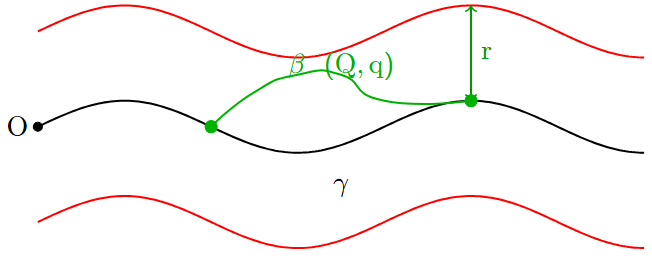
Consider a geodesic metric space \(X\) that admits a bounded quasi-geodesic combing. By Drutu, et al, we have that every path that is locally a morse quasi-geodesic is a globally weak morse quasi-geodesic, where the term "weak" corresponds to the sample quasi-geodesics with a particular quasi-geodesic parameters with no particular morse gauge function. By local, we mean that the property is true for a constant restricted parametrization of the path.

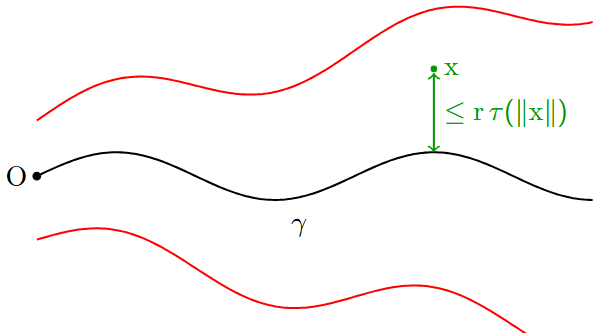
In our work, we consider sublinear neighborhood instead of uniform neighborhood version of the statement proved by Drutu, et al. A sublinear neighborhood, roughly speaking, grows sublinearly as you move away from base point, around a path. More precisely, a sublinear neighborhood of \(\gamma\) in \(X\) is \[\mathcal{N}_{\zeta}(m,\gamma)=\{x\in X\ \big\vert\ d(x,\gamma)\leq m\zeta(\|x\|)\}\] where \(\|x\|\) denotes the distance of \(x\) from the base point \(O\) of the space \(X\). Therefore, it is important to consider the base point more carefully and in most situtation, we assume the quasi-geodesics originate from the base point.
Now we consider \(\tau-\)sublinearly \(m-\)morse quasi-geodesic \(\gamma\) as a quasi-geodesic that contains every \((Q,q)-\)quasi-geodesic with endpoints on \(\gamma\) in its \(\mathcal{N}_{\tau}(m(Q,q),\gamma)\) sublinear neighborhood of \(\gamma\).
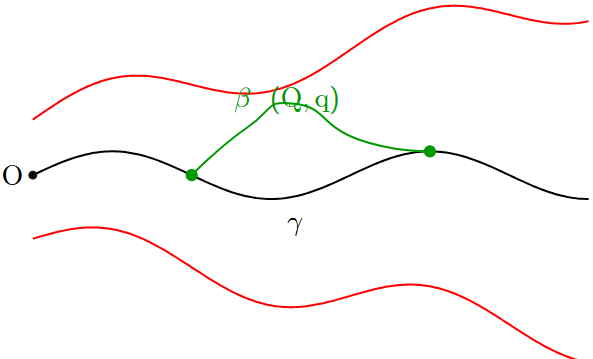
Now, we ask the question of whether the local-to-global property of sublinearly morse quasi-geodesic be true?
In more exact sense, is it true that in a geodesic metric space with bounded quasi-geodesic combing, every path
that is sublinearly locally sublinearly morse quasi-geodesic is a weak sublinearly morse quasi-geodesic?
We have made a partial progress in proving that it is global quasi-geodesic but it is not yet proved that is a
weak sublinearly morse quasi-geodesic.